
What Does Hospice Cover? A Complete Guide to the Medicare Hospice Benefit
Published by Compassionate Care Hospice | Serving Fresno, Modesto, Visalia, and many other locations across California
One of the most common questions families ask — often quietly, because they’re embarrassed to be thinking about money at a moment like this — is: “What does hospice cost?” The answer, for most patients, is: nothing. Here’s what the benefit actually covers.
The Short Answer: Hospice Is Covered
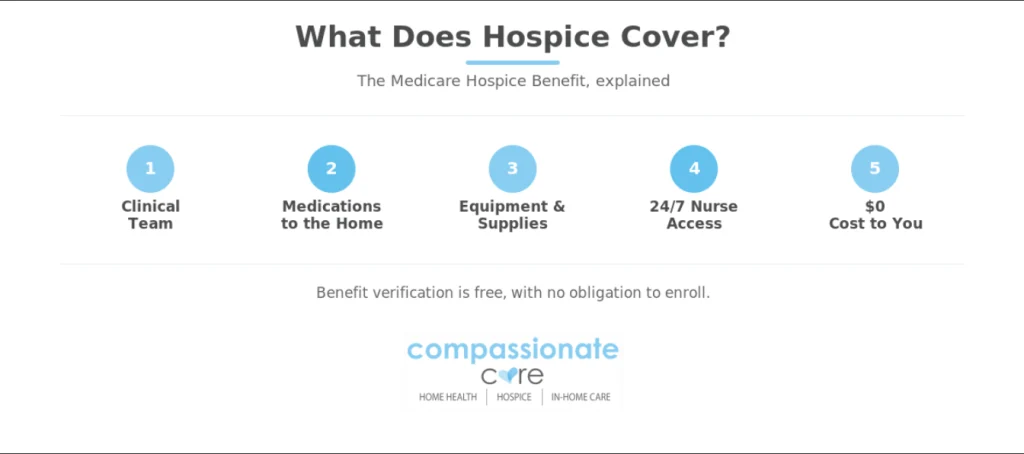
For the vast majority of patients Compassionate Care serves, hospice is covered at 100 percent by Medicare or Medi-Cal. There is no deductible. There is no copay. You will not receive a bill from Compassionate Care for hospice services.
That sentence — and being clear about it — is one of the most important things we can say to families. Financial worry is one of the silent barriers to hospice. Families sometimes decline care they need because they assume it will bankrupt them. They assume wrong.
This article explains exactly what the Medicare Hospice Benefit covers, what it doesn’t, and what questions to ask before you make any decision.
Who Qualifies for the Medicare Hospice Benefit?
To qualify for the Medicare Hospice Benefit, a patient generally must meet three criteria:
- Enrolled in Medicare Part A (most Americans 65 and older, and many younger people with qualifying disabilities)
- A physician certifies a prognosis of six months or less if the illness follows its expected course
- The patient chooses comfort-focused care rather than curative treatment for the terminal diagnosis
If these criteria are met, the benefit begins. California’s Medi-Cal program mirrors the Medicare Hospice Benefit for eligible patients. Commercial insurance plans typically cover hospice as well, and Compassionate Care verifies benefits before admission so families know exactly what is and isn’t covered before any decision is made.
What the Medicare Hospice Benefit Covers
Clinical Services — Visits to Your Home
The hospice benefit funds an interdisciplinary team that comes to wherever the patient calls home — a private residence, an assisted living facility, or a skilled nursing facility:
- Registered Nurse (RN) Case Manager — regular visits to assess symptoms, manage medications, coordinate care, and provide clinical oversight
- Licensed Vocational Nurse (LVN) — supplemental nursing visits as needed
- Hospice Aide — visits for bathing, grooming, and personal care
- Medical Social Worker — support for the patient and family around emotional wellbeing, community resources, advance directives, and family conflict
- Chaplain — spiritual care for any faith tradition, or for patients with no religious affiliation
- Volunteers — companionship, errand support, and caregiver respite
- Bereavement Counselor — grief support for the entire family for up to 13 months after the patient’s death
Medications Related to the Terminal Illness
All medications related to the terminal diagnosis — including comfort medications like pain relievers, anti-anxiety medications, anti-nausea medications, and breathing medications — are covered by the hospice benefit and delivered directly to the home. There is no pharmacy run required.
Medications unrelated to the terminal diagnosis (for example, a thyroid medication when the terminal diagnosis is heart failure) may continue under the patient’s Medicare Part D plan or be paid out of pocket, depending on the situation. The Compassionate Care hospice team reviews every medication individually and explains clearly what changes and why.
Medical Equipment and Supplies
Equipment delivered to the home — related to the terminal illness — is covered:
- Hospital bed
- Wheelchair or transport chair
- Bedside commode
- Shower chair or transfer bench
- Oxygen and oxygen supplies
- Suction equipment
- Pressure-reducing mattresses
- Walker or mobility aids
Wound care supplies, ostomy supplies, dressings, gloves, and other consumables related to the illness are also covered and delivered to the home.
24/7 On-Call Nurse Access
Every day. Every night. Every weekend and holiday. A Compassionate Care nurse is available by phone around the clock — not a call center, not a voicemail — to triage symptoms, answer family questions, and dispatch a nurse to the home when needed. This 24/7 access is one of the most consistently valued parts of the hospice benefit.
Higher Levels of Care When Needed
The Medicare Hospice Benefit includes four levels of care:
- Routine Home Care — the standard level; regular team visits with 24/7 phone access
- Continuous Home Care — 8 to 24 hours of nursing per day during a medical crisis at home, such as uncontrolled pain or respiratory distress
- General Inpatient Care (GIP) — short-term inpatient care at a contracted facility for symptoms that cannot be managed at home
- Respite Care — up to 5 days of inpatient care per benefit period to give the primary family caregiver a break
All four levels are covered by the Medicare Hospice Benefit.
What the Medicare Hospice Benefit Does NOT Cover
Being clear about the limits of the benefit is as important as explaining what it covers.
The benefit does not cover:
- Room and board at a skilled nursing facility (SNF) — this continues to be paid by Medi-Cal for eligible patients, or privately. The hospice care itself is still covered by Medicare; it’s only the room and board that is separate.
- Funeral expenses
- Experimental treatments not included in the plan of care
- Curative treatments for the terminal diagnosis — for example, chemotherapy aimed at curing the cancer (palliative chemotherapy or radiation for symptom relief may be covered in some cases; this is reviewed by the hospice medical director individually)
What About Medi-Cal Patients?
California’s Medi-Cal Hospice Benefit mirrors the Medicare benefit. For dually eligible patients (those with both Medicare and Medi-Cal), hospice care is billed to Medicare, and Medi-Cal may cover room and board costs at a SNF. Both coverages are verified by Compassionate Care before admission.
As of January 1, 2025, California became a Medicare Buy-In State for dually eligible patients, which means many patients who previously had only Medi-Cal are now auto-enrolled into Medicare Part A and may newly qualify for the Medicare Hospice Benefit.
What About Commercial Insurance?
Most commercial insurance plans include hospice coverage. The specific coverage — what’s covered, whether there are any copays, which providers are in-network — varies by plan. Compassionate Care verifies benefits before any patient is admitted, so families have a clear picture before they make a decision.
Before Any Decision: Benefit Verification at No Cost
One of the first things Compassionate Care does when a family contacts us is verify the patient’s insurance benefits — in detail, in writing — so there are no surprises. This happens before any paperwork is signed and before any services begin.
Our goal is that every family understands exactly what they’ll receive and exactly what it will cost them before they make any decision. For nearly all of our patients, the answer is the same: you will not receive a bill from us for hospice care.
Frequently Asked Questions About Hospice Coverage
Q: Does my family member have to stop seeing their regular doctor? No. The patient’s primary care physician can remain involved and continues to bill Medicare for professional services. Most specialists for conditions unrelated to the terminal diagnosis can also continue.
Q: Will all my loved one’s medications be stopped? No. Comfort medications stay or are added. Preventive medications that are no longer serving the goal of comfort may be deprescribed — but every change is explained, and the family has the final say.
Q: Can hospice patients still go to the hospital? Patients can always choose to go to the hospital. However, for most hospice patients, the goal is to manage symptoms at home. If symptoms escalate beyond what routine home care can manage, the hospice benefit includes Continuous Home Care and General Inpatient levels that provide hospital-level care in a more comfortable setting.
Q: What happens to coverage if my family member improves? If a patient improves enough that they no longer meet hospice eligibility criteria, they are discharged from hospice — what we call graduating. They return to their regular Medicare benefits. If they later decline again, they can re-elect hospice. There is no penalty and no limit on re-election.
Talk to Compassionate Care About Coverage
Cuidados Compasivos Hospicio serves families across Fresno, Modesto, Visalia, and surrounding California communities. We offer both Home Health and Hospice services, so many families transitioning to hospice are already familiar with our team.
If you have questions about what hospice would cost your family, or whether your loved one qualifies, call us. The evaluation is free. Benefit verification is free. And there is no obligation to enroll.
The conversation costs nothing. The care costs nothing. Let’s talk.
© Compassionate Care Hospice. This article is written for educational purposes and is not a substitute for individualized insurance or legal advice. Coverage details vary by individual insurance plan. Compassionate Care verifies all benefits prior to admission.
Sigue leyendo
Artículos relacionados
Comienza hoy
Toma el primer paso
con atención compasiva.
Apoyo confidencial y compasivo, a una llamada o un clic de distancia.
Comienza hoy
Cuéntanos sobre las necesidades de tu ser querido y nos pondremos en contacto de inmediato.