
When Is the Right Time for Hospice? Signs Families Often Miss
Published by Compassionate Care Hospice | Serving Fresno, Modesto, Visalia, and more locations across California
If you’ve found this article, you’re probably watching someone you love change — and you’re trying to figure out what those changes mean. This is for you.
The Most Common Regret in Hospice Care
In our years of caring for patients and families across California, one thing is said more often than almost anything else: “I wish we had called sooner.”
Not because hospice is easy. Not because it isn’t emotionally hard. But because the months of support that hospice can provide — the symptom management, the team at the door, the nurse available at 2 a.m., the aide for showers, the social worker, the chaplain, the equipment delivered right to the home — those months are lost when families wait too long.
Nationally, more than half of hospice patients enroll within the last 30 days of life. The Medicare Hospice Benefit was designed for the last six months of life. That’s a gap of approximately five months during which families carry an enormous burden alone — and patients suffer symptoms that could be controlled.
This article is about recognizing the signs before it’s too late to use what hospice offers most.
What the Medicare Hospice Benefit Is Actually For
The Medicare Hospice Benefit is available when a physician certifies that a patient has a prognosis of six months or less if the illness follows its expected course. This does not mean the patient will definitely die in six months — it means that the disease trajectory, if it continues as expected, points in that direction.
Patients who enroll and later improve are discharged — what the hospice world calls “graduating” — and can return to traditional Medicare. If they decline again, they can re-elect hospice. The benefit is flexible, not permanent.
The six-month threshold is not a cliff. It is an entry point into a form of care that most patients wish they had accessed earlier.
Signs That It May Be Time to Have the Conversation
These signs don’t appear in every patient, and no single sign is a diagnosis. But in combination — especially as a pattern over weeks and months — they are the clinical signals that hospice-trained nurses and physicians look for. If you are seeing several of these in someone you love, it is worth calling.
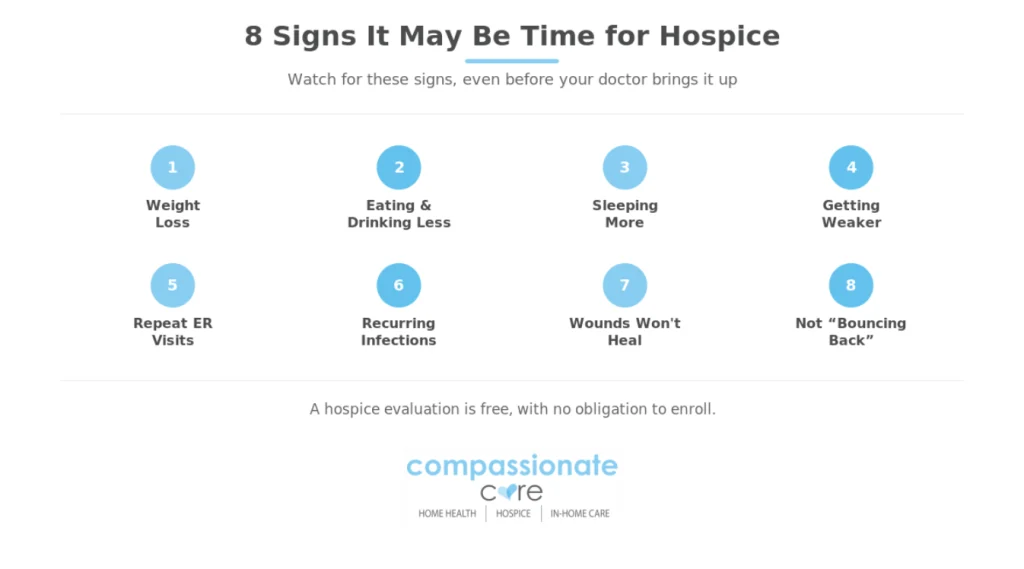
1. Unintentional Weight Loss
Gradual, unexplained weight loss — 10% or more of body weight over six months — is one of the most consistent indicators that a body is losing its ability to sustain itself. It often happens slowly enough that families don’t notice the cumulative shift until it’s significant.
2. Eating Less, Drinking Less
A shrinking appetite is more than a nutrition concern. It signals that the body is shifting its energy priorities. When someone who used to love food begins leaving plates untouched — or stopping eating altogether — that is meaningful clinical information.
3. Sleeping More
As illness progresses, patients often sleep longer and more deeply. They may be harder to wake, or sleep through visits that used to excite them. This is the body conserving energy, not the person being “lazy.”
4. Walking Less, Getting Weaker
Reduced mobility — needing more help with transfers, spending more time in bed or in the chair, being unable to walk without assistance — represents a measurable functional decline that hospice clinicians assess as part of eligibility evaluation.
5. Repeat Emergency Room Visits or Hospitalizations
Two or more ER visits or hospitalizations within six months — especially for the same underlying problems — is a strong signal that the current treatment plan is no longer managing the disease effectively. Each hospitalization often leaves the patient a little weaker than before.
6. Infections That Keep Coming Back
Recurring urinary tract infections, aspiration pneumonia that keeps returning, or infections that don’t respond as well to antibiotics as they used to — these are signs of a compromised immune system and a body that is struggling.
7. Wounds That Won’t Heal
Non-healing pressure injuries, chronic wounds that stall or worsen despite good care, or skin that tears easily — these reflect poor circulation, nutritional depletion, and reduced healing capacity.
8. A Sense That Things “Aren’t Bouncing Back”
This one is harder to put in a chart, but it’s often the most accurate. Families say it as: “She just isn’t coming back from this the way she used to.” That sense — the subjective, observational wisdom of the people who know the patient best — is clinically meaningful and worth sharing with a hospice eligibility nurse.
Is It Too Early? Almost Never.
One of the most common things families say when they first hear the word “hospice” is: “Isn’t it too early?”
In the overwhelming majority of cases, the answer is no.
Patients can revoke hospice at any time. Patients who improve can graduate. There is no penalty for evaluating and deciding it isn’t the right moment. The evaluation itself is free and carries no obligation.
But the window in the other direction — too late — is real and irreversible. Families don’t get those weeks back. The comfort, support, and preparation that hospice provides in the final months cannot be retroactively given.
If you’re asking whether it might be time, that question itself is a signal worth following.
“But the Doctor Hasn’t Said Anything”
This is more common than most people realize. Research from the Center to Advance Palliative Care (CAPC) and the National Hospice and Palliative Care Organization (NHPCO) consistently shows that 20 to 40 percent of seriously ill patients have never had a clear end-of-life conversation with their physician.
Physicians are extraordinary at treating disease. Many are less trained — and less comfortable — having prognostic conversations with patients and families. It is not a failure of caring. It is often the opposite.
If you feel like you haven’t been given the full picture, you have the right to ask for it. And at Compassionate Care, our hospice physicians and nurse practitioners are skilled at providing exactly that clarity — with honesty, compassion, and without pressure.
What Happens During a Free Hospice Evaluation?
The evaluation is a no-obligation visit from a Compassionate Care hospice eligibility nurse. Here’s what it is — and what it isn’t:
What it IS:
- A clinical review of the patient’s current condition, medications, history, and trajectory
- An honest conversation about what hospice offers and whether the patient currently qualifies
- A chance for the family to ask every question they have
- A chance to meet the team before any decision is made
What it is NOT:
- A commitment to enroll
- A form-signing event
- A one-way door
Many families use the evaluation visit simply to gather information — and choose to enroll weeks or months later, when they feel ready. The visit doesn’t start the clock on anything.
The Compassionate Care Advantage: Already There
At Cuidado compasivo, we offer both Servicios Médicos a Domicilio y Cuidados services across California, including Fresno, Modesto, and Visalia. Many of our hospice patients have already been with us through home health.
That means the nurse who’s been visiting your mother for six months doesn’t disappear when hospice begins. The face you already trust — the team you already know — stays with you. We add more support. We don’t start over.
If your loved one is already a Compassionate Care Home Health patient and you have questions about hospice, speak with your home health nurse or ask to be connected with our Hospice Eligibility team. The conversation is free. The evaluation is free. And there is no obligation whatsoever.
The Right Time Is Usually Now
If you’ve read this far, you’re asking the right questions. The most important thing we can tell you is this:
The right time to have the conversation is before you’re certain it’s time.
Call us. Let us come out. Let you and your family ask every question. Let the information be in the room before the crisis arrives.
That is the kindest thing you can do for the person you love — and for yourself.
© Compassionate Care Hospice. Written for educational purposes. Clinical references: NHPCO Facts and Figures (2023 edition); Connor SR et al., J Pain Symptom Manage 2007; CAPC state-by-state palliative care data.
About Compassionate Care Hospice Compassionate Care Hospice is a California-based provider of Home Health and Hospice services, serving patients and families across Fresno, Modesto, Visalia, and surrounding California communities. Our bilingual, interdisciplinary team provides 24/7 on-call nurse support, home-delivered medications and equipment, and bereavement support for families for up to 13 months after the loss of a loved one.
Sigue leyendo
Artículos relacionados
Comienza hoy
Toma el primer paso
con atención compasiva.
Apoyo confidencial y compasivo, a una llamada o un clic de distancia.
Comienza hoy
Cuéntanos sobre las necesidades de tu ser querido y nos pondremos en contacto de inmediato.