
A Guide for Families; What to Expect in the Last Days of Hospice
When a loved one enters hospice care, families often feel a mix of emotions- relief that professional support is in place, sadness about the approaching end, and uncertainty about what lies ahead.
The last days of life bring many questions and sometimes fears-
- What will my loved one look like?
- Will they be in pain?
- How do I know when the time is near?
While every person’s journey is unique, there are common signs and experiences families can prepare for during the final days of hospice care. Understanding what to expect can help ease anxiety, foster meaningful moments, and empower families to provide comfort when it matters most.
The Physical Changes- What You May See, and Why
The body undergoes physical changes when nearing its end of life. These may be more noticeable, or more subtle, depending on the individual.
In the final days, the body begins to slowly shut down. This process is deeply personal. No two people complete their end-of-life phase in the same way, but there are common physical signs that indicate the end is near.
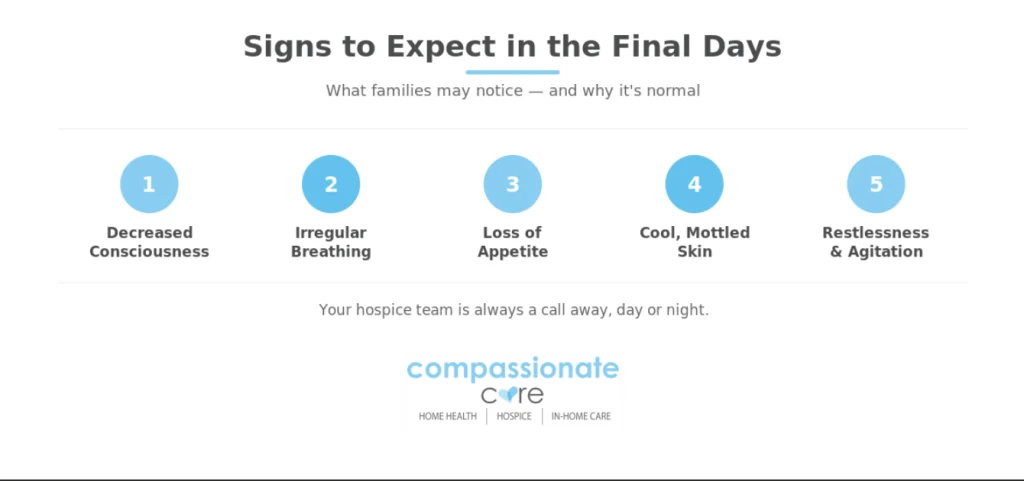
- Decreased consciousness. Your loved one may drift in and out of awareness, or become unresponsive altogether. This doesn’t necessarily mean they’re suffering. In fact, many people describe this stage as peaceful. The body conserves energy by focusing only on essential functions.
- Irregular breathing. Breathing may become shallow, labored, or interrupted by long pauses. This is known as Cheyne-Stokes breathing. Although it can be distressing to witness, it isn’t typically painful.
- Lack of appetite. As organs begin to shut down, the body no longer needs food or fluids. Trying to feed someone in their final days can cause discomfort. Moistening their mouth or lips can provide comfort instead.
- Cool skin and mottling. Hands and feet may feel cold or appear bluish or blotchy as circulation slows. Blankets can help with comfort, but these changes are a normal part of the dying process.
- Increased restlessness or agitation. Some patients experience a period of confusion or fidgeting, sometimes called “terminal agitation.” This can be caused by metabolic changes, medications, or even emotional factors. Hospice nurses are trained to recognize and respond to these symptoms with gentle, calming interventions.
Hospice teams monitor these changes closely. If anything is concerning to you, call them, even in the middle of the night. You are not expected to manage this alone.
Comfort and Care in the Final Hours
In the final hours of life, every gesture, every moment, and every decision centers on one core principle- comfort. When curative treatments are no longer the focus, the goal becomes something much more personal ensuring that the person you love feels safe, soothed, and at peace. Hospice care exists to support that experience, not only medically, but emotionally and spiritually as well.
Pain management is often one of the first concerns families have, and understandably so. The idea of someone suffering at the end is one of our deepest fears. Hospice teams take this concern seriously. Medications like morphine or other opioids are carefully administered not to hasten death, but to ease discomfort and support more relaxed breathing.
But comfort isn’t just about medication. It’s also in the small, compassionate details the gentle repositioning of the body to prevent soreness or stiffness; the quiet dignity of being cleaned, having one’s lips moistened, or being tucked under a warm blanket. Hospice aides provide this intimate care with deep respect, often forming a close bond with both the patient and family. These acts may seem simple, but they hold immense meaning. They are a way of saying, You still matter. You are still worthy of tenderness.
Symptom management in the final stage is also a vital part of care. Shortness of breath, restlessness, secretions, or nausea can arise even in those who were relatively stable just days before.
Hospice teams are trained to anticipate these changes and to respond with both medications and non-pharmaceutical options, such as adjusting the environment or using oxygen or fans for comfort. Families are encouraged to voice any concerns, no matter how small they might seem. Nothing is too minor when it comes to a loved one’s comfort.
Most of all, hospice ensures that no one has to navigate these hours alone. Nurses may check in more frequently or stay with the family for longer stretches. On-call staff are available 24/7, so whether a question arises at 2 p.m. or 2 a.m., there is someone who will answer the phone, come to the home, and guide you through what’s happening. Their presence doesn’t remove the pain of loss, but it can ease the fear that often surrounds it.
The last hours of life don’t have to be filled with chaos or panic. In many cases, they unfold quietly, gently even beautifully. With the right support, families can spend these final moments focused on what matters most- whispering words of love, holding hands, sharing silence, and honoring the life that is coming to a close.
Emotional Presence- How to Support Without Needing to “Fix” Anything
Families often feel a deep desire to do something- to ease the person’s pain, to say the right thing, to make the moment easier. But the most powerful thing you can do in the last days is simply to be there.
That doesn’t mean sit in silence and wait for something to happen. It can be as simple as saying words that reassure the individual that their life mattered to you. While some may prefer silence, that does not always have to be the case.
Here are some ways that you can be present for your loved one during their final weeks or days-
- Quiet companionship. You don’t need to talk. Just being present, holding a hand, or playing soft music can be enough.
- Speak from the heart. If you have things to say – words of love, gratitude, forgiveness, or farewell, this is the time. Even if your loved one seems unresponsive, many hospice workers will tell you- hearing is believed to be the last sense to go.
- Lean on spiritual resources. Whether through a chaplain, religious leader, or personal ritual, spiritual support can bring comfort and meaning to both you and your loved one in these final days.
- Invite others to say goodbye. Some families find it helpful to give close friends or extended relatives a chance to visit or call, if that’s something your loved one would want.
In these moments, think about the person who is receiving hospice. What kinds of interactions with others would they want? Take a moment to consider the individuals they would perhaps like to see the most in their final moments and make the necessary arrangements for them to visit.
When the Moment Comes- What Death Looks Like
Despite all the worry and anticipation, many families describe the moment of death as quiet. Breathing slows, then stops. There’s a stillness that settles in.
When this happens, you may feel unsure of what to do. This is normal, and though it can be distressing or confusing at first, it is also because there is not anything more that can be done. There’s an innate part of every person that wants to help, wants to undo the passing of someone they love, but unfortunately the focus needs to shift in this moment from comforting someone to honoring their life and legacy.
When the person receiving hospice does pass, call your hospice team. They will handle the essential duties, such as-
- Confirming the death of the individual
- Handling necessary documentation
- Walk you through next steps with gentleness and care.
It’s common to feel a mix of emotions immediately after- grief, shock, relief, numbness. There is no right way to feel. Just allow space for whatever comes. You are allowed to take your time, and you do not need to rush this process.
Eventually, once the person has passed, the hospice team will handle or coordinate the respectful removal of their remains so that they can be prepared for an eventual cremation or burial. If you want to hold a memorial service for them, you can also begin reaching out to nearby memorial facilities over the next few days to begin arrangements.
Caring for Yourself in the Aftermath
In the days following, you may feel disoriented. You’ve been holding vigil sometimes for days, weeks, or months. Now everything is still.
Know that hospice care doesn’t end the moment your loved one dies. Most teams offer bereavement services for a year or more. Counseling, support groups, and follow-up calls are available to help you process your grief.
Don’t try to go back to “normal” right away. Grief reshapes life, and healing takes time. Fatigue, forgetfulness, or unexpected waves of emotion are part of that process. Be gentle with yourself. Accept help. And trust that you don’t have to navigate this next chapter alone.
Lastly, it’s important to know that hospice provides continued support for family members of those who have passed. From navigating the logistics of burials, cremations, choosing funeral homes, and connecting individuals emotional and spiritual care resources, you do not have to face this new chapter alone.
Care Through Every Phase of the Journey
The final days of life are sacred ground. They’re full of heartbreak, yes, but also love, closeness, and moments that leave lasting meaning. Being there for someone at the end of their life is one of the most profound acts of care a person can offer.
You do not need to know everything. You do not need to be perfect. You only need to show up with love, patience, and presence.
And when you’re overwhelmed, tired, or uncertain, remember this- hospice is here. Not just for the patient, but for you too. You are not alone.
At Compassionate Care, we believe in partnering with you and your loved one in the most vulnerable phase of life’s journey- the end. Serving all of California, we will assist you in planning the care for your loved one in a way that provides them with the utmost comfort, dignity, and attention to detail. Contact us today to learn more about how we can assist you.
Keep Reading
Related articles
Get Started Today
Take the first step
with compassionate care.
Confidential, compassionate support, one call or click away.
Get Started
Tell us about your loved one's needs and we'll reach out right away.