
Step-by-Step Guide- How to Arrange Home Health Care for a Loved One
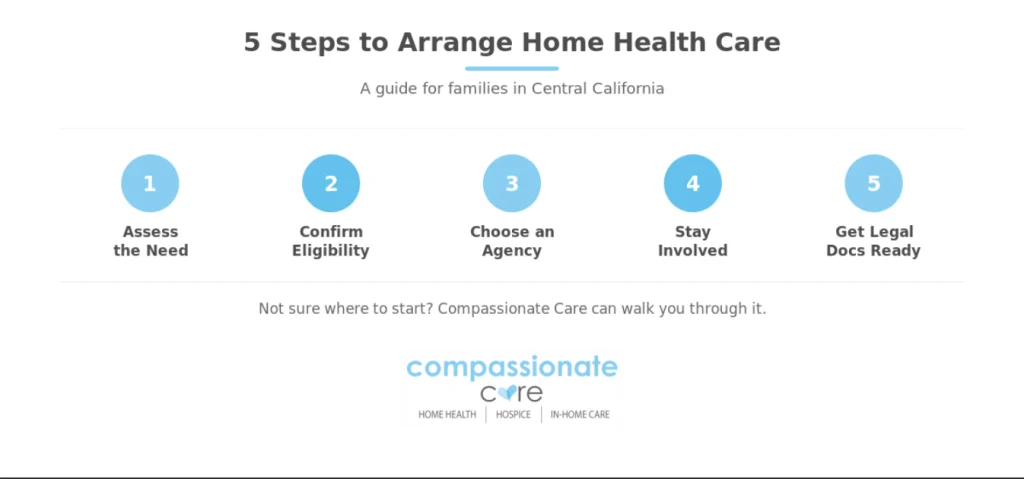
What We’re Talking About: Arranging home health care can be stressful and overwhelming, especially when you are trying to find the best at-home support for your loved one. In this guide, we’ll take you through everything you need to know to start the process. Contact our team at Compassionate Care anytime for more personalized guidance.
No one ever thinks they’ll be the one making care decisions for a parent, spouse, or sibling. Then suddenly, you’re sitting across from a discharge planner, or you’re noticing that the little things your loved one used to do: managing medications, getting dressed, and keeping the house in order just aren’t happening anymore.
You don’t need to have all the answers right away. But you do need a place to start.
If you live in Central California and you’re exploring home health care, here’s what the process looks like and how to move through it with clarity and compassion.
Start with One Question- What Kind of Help Does Your Loved One Truly Need?
This is the moment to look honestly at what’s changed. Are they recovering from surgery? Struggling with a chronic condition like COPD or diabetes? Showing signs of memory loss or confusion? Or are they simply slowing down in ways that make independent living unsafe?
In California, home health care refers specifically to medical care provided at home, under a doctor’s direction. That might include skilled nursing, physical or occupational therapy, wound care, and monitoring of vital signs or medications. It’s different from personal caregiving, which is more about support with daily living, providing non-medical services such as bathing, dressing, meals, and much more.
Before anything else can happen, a physician has to evaluate your loved one and determine whether home health is medically necessary. If they haven’t seen their doctor recently, schedule that appointment. It’s not just red tape, it’s the first step toward getting coverage through Medicare, Medi-Cal, or private insurance.
Know What California Offers (and Doesn’t)
California follows federal Medicare rules when it comes to eligibility. That means your loved one must-
- Be considered homebound (leaving the house requires significant effort),
- Needs intermittent skilled care (not full-time, round-the-clock help),
- Have a physician create a Plan of Care ordering home health services.
Where California differs is in its additional supports, especially for low-income residents. One of the most important state-run programs is IHSS (In-Home Supportive Services).
If your loved one qualifies for Medi-Cal, IHSS can provide financial support to pay a caregiver (often a family member) to help with non-medical needs like dressing, cooking, or mobility. The process involves an in-home needs assessment and county approval.
Before any of this can begin, the individual must be considered eligible for home health services. This means that a board-certified physician has reviewed the patient’s case and has determined that they meet the criteria for home health and can be prescribed this treatment.
Visit cdss.ca.gov/In-Home-Supportive-Services or contact your county social services agency. If approved, this can make a huge difference in sustaining care at home.
Choosing the Right Home Health Agency
Once the physician has signed off on medical eligibility, you’ll need to choose a licensed home health agency. California regulates these through the Department of Public Health (CDPH), and you can search for agencies by county using their Home Health Agency Search Tool.
However, not all agencies are created equal. As you review our options look for-
- Accreditation (like from The Centers for Medicare & Medicaid Services)
- Positive reviews or references from your community
- Clear communication about services, schedules, and staff credentials
You have the legal right to choose any Medicare-certified agency that serves your area, even if the hospital refers you to one specifically. Be sure to conduct your own research, reach out to agencies that you feel might closely align with your specific needs, and meet with as many as you are comfortable with before making your final decision.
After Services Begin- Stay Involved
Home health doesn’t mean hands-off. You or another trusted family member should stay in close contact with the care team. Check that visits are happening as scheduled, ask questions if something seems off, and don’t hesitate to call the agency or physician if your loved one’s condition changes.
Legal and Practical Considerations in California
When you’re stepping in to coordinate care for someone else, there’s more to think about than just medical logistics. California has specific legal frameworks in place to protect patients’ rights, but they can also limit your ability to help unless certain documents are in order.
Below are some legal factors to consider. If you are considering obtaining any legal statuses to help support a loved one, you may also want to reach out to a family lawyer, elder lawyer, or estate lawyer to assist with these processes.
1. Advance Health Care Directive (AHCD)
In California, this is the most important legal document for expressing a person’s medical wishes and naming someone to speak on their behalf if they can’t. It combines two essential elements- a living will (what kind of care they want or don’t want) and medical power of attorney (who should make decisions for them).
If your loved one doesn’t already have one in place, don’t wait. Without it, doctors will default to next of kin, and disagreements between family members can delay or complicate care.
- Who should have one? Everyone over 18, but especially older adults or those with chronic illnesses.
- Where to get it? Download the official form from the California Attorney General’s Office. No lawyer is required, it just needs to be signed in front of two witnesses or a notary.
It is best to also keep a copy in the home, another with the person named as the health care agent, and one with the primary doctor. EMTs and hospital staff are not obligated to search for the document unless it’s readily available.
2. HIPAA Authorization & Access to Medical Records
Even if you’re the one coordinating every appointment, insurance call, and home health visit, federal and California privacy laws (HIPAA) prevent health care providers from sharing information with you unless your loved one signs a HIPAA release form.
This is especially critical if your loved one-
- Has memory impairment or dementia
- Is hospitalized or in post-acute recovery
- Or simply wants you to act on their behalf
You can ask the physician or home health agency for a HIPAA form directly, or use one from the California Medical Association.
Download a general HIPAA release here- CMA HIPAA Release (PDF)
3. Durable Power of Attorney (DPOA) – For Finances and Broader Legal Authority
Health care is just one piece. If your loved one needs help managing their finances, paying for services, dealing with Medi-Cal, applying for IHSS, then you’ll also need a Durable Power of Attorney for Finances.
This legal document allows you to handle essential financial priorities like-
- Bank accounts
- Insurance paperwork,
- Long-term care applications (like IHSS or Medi-Cal Waivers)
- Paying home care providers.
A DPOA must be created while your loved one is still mentally competent. If it’s too late, you may have to go through conservatorship proceedings in probate court, which can become an expensive and time-consuming process.
California seniors (60+) may qualify for low-cost or free legal assistance through nonprofit legal aid groups. Start with LawHelpCA.org or call your local Area Agency on Aging.
4. Mandatory Reporting and Elder Protection Laws
It’s worth knowing- In California, home health professionals are mandated reporters. That means if they suspect your loved one is being neglected, abused, or exploitedfinancially or otherwisethey are legally required to report it to Adult Protective Services (APS).
This is not something to be afraid ofit’s a safeguard. But it does mean that anyone involved in care needs to act transparently and in your loved one’s best interest. If you’re concerned about an issue yourself, you can also call APS directly at 1-833-401-0832, or visit cdss.ca.gov/Adult-Protective-Services.
These documents and protections aren’t just red tape. They’re toolsways to make sure your loved one’s voice is respected, even when they can’t speak up for themselves. And they help you, as the caregiver, avoid legal and emotional roadblocks that too often show up in a crisis.
If you’re not sure where to start, talk with your loved one gently but honestly. Begin with one simple question- “If something happens and you can’t speak for yourself, who do you want to speak for you?” From there, the rest can follow.
Are You Ready for Home Health? Get Started Today
As mentioned earlier, choosing the right home health agency is not a simple task. It’s an emotional decision that could directly affect the health and wellness of an individual when recovering from a condition.
Do your research, have conversations with your loved ones, and don’t be afraid to interview multiple agencies. Ultimately, choosing the right care comes down to your own decision-making.
If you live in Central California, contact Compassionate Care today to learn more about our home health agency services. We will work with you and your loved ones through every step of the process to provide you with answers to any questions you have and give you the confidence you need to make your decision.
Keep Reading
Related articles
Get Started Today
Take the first step
with compassionate care.
Confidential, compassionate support, one call or click away.
Get Started
Tell us about your loved one's needs and we'll reach out right away.