
What’s Included in Palliative Care vs. Hospice Care?
When someone you love is beginning their end-of-life journey, you’re suddenly faced with decisions you never expected to make. Amid medical updates, care plans, and shifting emotions, you may hear physicians mention terms like palliative care and hospice care as options for the next phase of treatment.
They sound similar, and they are in many ways, but they aren’t the same. And understanding those differences can help you make choices with greater clarity and confidence.
Let’s take a closer look at what each type of care includes, how they overlap, and how they support both patients and families when serious illness becomes part of life.
What Palliative Care Includes
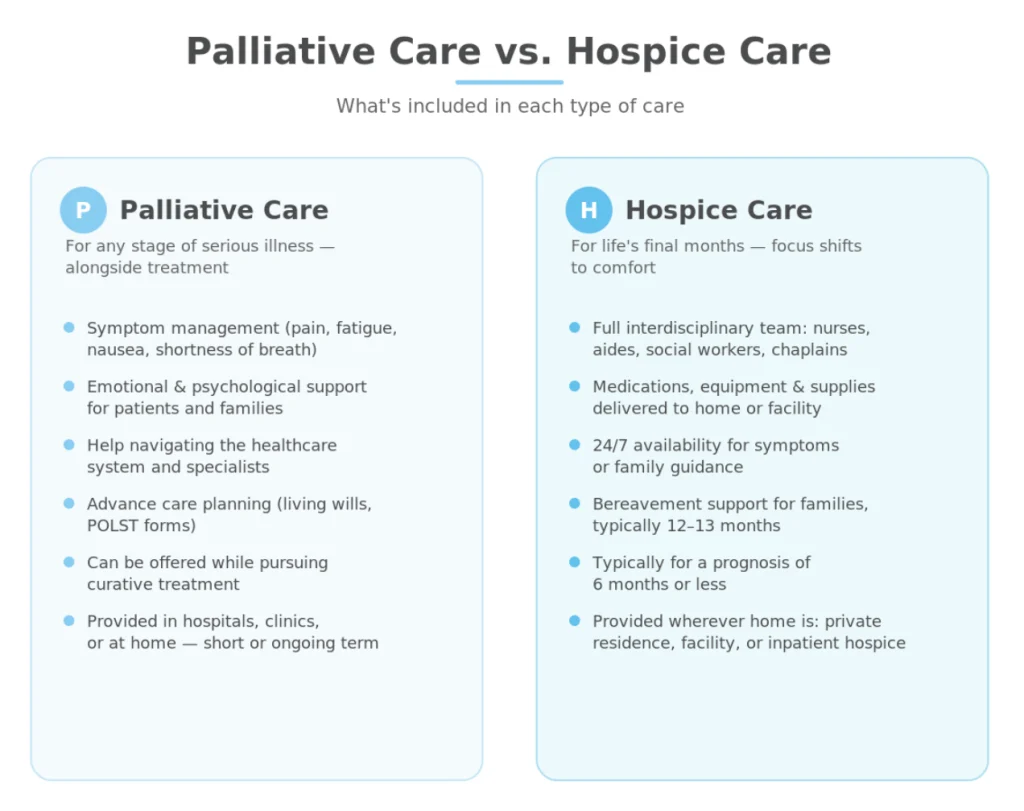
Palliative care is specialized medical care focused on providing relief for the symptoms, stress, and emotional weight of a serious illness at any stage and alongside curative treatment. It isn’t limited to the final months or weeks of life, and it isn’t just for cancer patients. People with heart failure, COPD, Parkinson’s, dementia, kidney disease, and other chronic conditions may all benefit from palliative support.
Here’s what palliative care typically includes-
- Symptom management. Pain, fatigue, nausea, shortness of breath, and other distressing symptoms are addressed directly. The goal is to improve quality of life, whether a person is newly diagnosed or years into treatment.
- Emotional and psychological support. Serious illness doesn’t just affect the body, it touches every part of life. Palliative teams often include social workers, counselors, or chaplains who help patients and families process uncertainty, fear, or changing roles.
- Help navigating the healthcare system. A palliative care provider can serve as a guide coordinating care, communicating with specialists, and helping families understand what options are available and what those options mean in real life.
- Advance care planning. Palliative care can help clarify goals of care, explain documents like living wills or POLST forms, and support decisions that reflect a patient’s values.
Palliative care is often provided in hospitals, but it’s increasingly available in clinics, long-term care facilities, and even at home. It can be short-term or ongoing. And importantly, it can be offered while someone is still pursuing aggressive treatment.
What Hospice Care Includes
Hospice care is a type of palliative care, but with a more specific purpose- supporting people who are in the final stage of a terminal illness, when the focus has shifted from cure to comfort. In the U.S., hospice is typically introduced when a doctor believes the patient has six months or less to live if the illness runs its expected couse.
Hospice care includes everything palliative care offers, plus-
- A full interdisciplinary care team. Hospice patients are cared for by a team that includes nurses, aides, social workers, chaplains, and doctors, all working together to care for the whole person body, mind, and spirit.
- Medications, equipment, and supplies. Hospice covers medications related to comfort (like pain relief), as well as items such as a hospital bed, oxygen, adult briefs, and wound care supplies, delivered directly to the home or facility.
- 24/7 availability. Hospice teams are on-call around the clock. Whether a patient is struggling with symptoms or a family member just needs guidance, someone is always there to help.
- Bereavement support. Hospice continues caring for families even after the patient has died, offering grief counseling, support groups, and follow-up calls often for 12 to 13 months.
- Care wherever home is. Hospice can be provided in a private residence, assisted living, nursing home, or dedicated inpatient hospice facility.
Hospice care doesn’t mean “giving up.” It means choosing a type of care that prioritizes quality of life in whatever time remains. For many, hospice allows for more peace, more presence, and a gentler experience for both patient and family.
What They Share and Why That Matters
Both palliative and hospice care treat the person, not just the illness. They ask what matters to the patient, not just what’s medically possible, and tailor care accordingly. Both emphasize dignity, communication, and comfort. And both remind families that they don’t have to carry this alone.
But knowing where they differ can shape important choices. For example-
- If your loved one is still pursuing treatment like chemotherapy, dialysis, or surgery but needs help managing side effects, palliative care may be the right fit.
- If your loved one has decided to stop curative treatments and wants care that focuses solely on comfort and quality of life, hospice care is likely the better match.
Neither path is about abandoning hope. In fact, many families find that once pain is under control and car is centered on comfort, space opens up for conversation, connection, or even just moments of quiet peace.
Get Compassionate Hospice Care in California
There is no “right” time to ask about palliative or hospice care – only a right time for you and your loved one. These services aren’t about counting down days. They’re about improving the days that remain, whatever that looks like for your family.
If you’re unsure what type of care is appropriate, ask questions. Speak to your loved one’s doctor, or reach out to a local hospice or palliative care provider. You’re not expected to know everything. What matters is that you’re looking for the kind of support that honors the person at the center of it all.
That, in the end, is what both palliative and hospice care are truly about.
If you are seeking options for yourself or a loved one facing the end-of-life phase of your journey, contact our team at Compassionate Care today. We provide care to residents of California, with locations serving individuals and families from Stockton to Bakersfield and surrounding areas.
Keep Reading
Related articles
Get Started Today
Take the first step
with compassionate care.
Confidential, compassionate support, one call or click away.
Get Started
Tell us about your loved one's needs and we'll reach out right away.