
What’s the Difference Between Home Health and Hospice? A Simple Breakdown
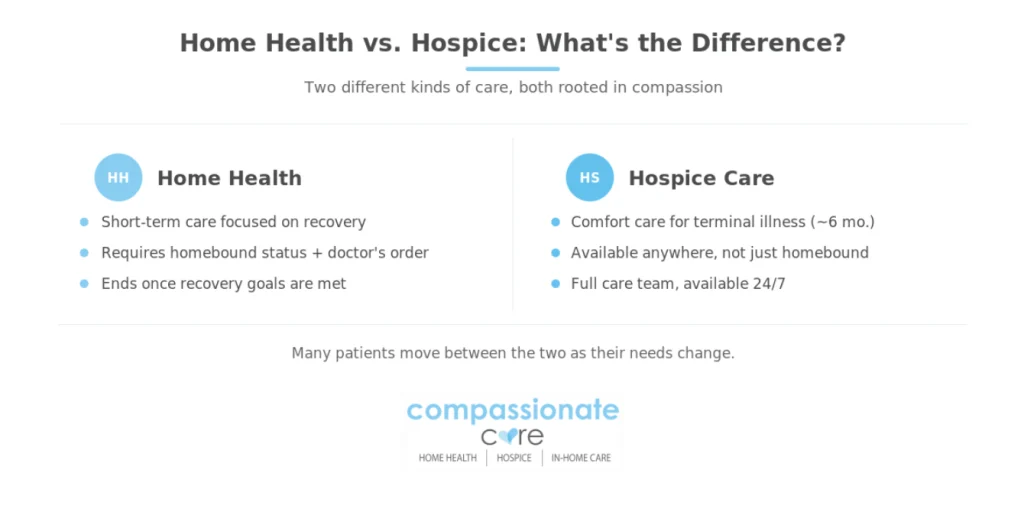
What We’re Discussing: Home health and hospice may sound similar, but they are different types of care. Home Health is focused on getting better with short-term, goal-oriented treatments. Hospice care supports quality of life at the end of one’s life to ensure they can enjoy their last moments with comfort and dignity.
When a loved one’s health begins to change—whether it’s after a surgery, during a chronic illness, or near the end of life—families often find themselves facing complicated decisions. Two of the most common care options they hear about are home health and hospice. But despite how often these terms come up, they’re often misunderstood, even by people within the healthcare system.
And that’s a problem—because choosing between home health and hospice isn’t just a medical decision. It’s personal. It’s emotional. And it deserves better explanations than what most online sources provide.
Let’s take a clear, honest look at what sets these two types of care apart, so families can feel more confident, informed, and supported.
Home Health: Care Focused on Getting Better
Home health care is meant for people who are recovering or stabilizing. It’s short-term, goal-oriented medical support delivered right at home.
Typical situations where home health makes sense include:
- Someone recovering from surgery who needs help with wound care or physical therapy
- An older adult with a new diagnosis of diabetes who needs education and monitoring
- A person managing a chronic condition like heart failure who’s had a recent hospitalization
To qualify for home health eligibility under Medicare (and most private insurance plans), a person must be homebound and have a medical need for occasional skilled services—like at-home nursing care, physical therapy, or speech therapy. These services must also be prescribed by a doctor in order to receive appropriate coverage.
What makes home health unique is its emphasis on restoration. The goal is to improve or stabilize the patient’s condition so they can regain independence. Care is typically provided a few times a week, and once the person has reached their recovery goals, services end.
It’s important to know: home health is not intended for people who need daily help with things like bathing, dressing, or meals—that would fall under personal care or home care services, which are separate.
Hospice: Comfort and Quality of Life Near the End
Hospice, on the other hand, is for people who are facing a terminal illness and are no longer pursuing curative treatments.
It should be noted that hospice should never be considered “giving up.” Instead, it’s about shifting the focus from aggressive medical intervention to comfort, dignity, and quality of life.
To be eligible for hospice, a physician must certify that the person is likely in the last six months of life if the illness follows its expected course. Unlike home health, hospice care is available even if the person is not homebound, and it can be provided in one’s home, assisted living facilities, or nursing homes.
Hospice is fully covered by Medicare, Medicaid, and most private insurers. And unlike home health, hospice offers a comprehensive team approach. That team may include:
- Hospice nurses who manage pain and symptoms
- Home health aides who assist with bathing and personal care
- Social workers and faith leaders who can provide emotional and spiritual support
- Physicians and nurse practitioners who oversee the care plan
- Volunteers and bereavement counselors who support both the patient and family
Another key difference is that hospice provides support as needed at any times of the day or week. If something changes in the middle of the night, such as a new symptom, a sudden decline, there’s someone to call. The emphasis is always on comfort, choice, and helping families make the most of the time they have together.
One Isn’t “Better” Than the Other
Home health and hospice aren’t two versions of the same treatment. They serve different medical and emotional needs. One is focused on healing; the other on comfort. One hopes for a return to function while the other embraces peace during the last chapter of life.
That said, they aren’t mutually exclusive. Many patients transition from home health to hospice as their illness progresses. Others may leave hospice to pursue curative treatment if their condition unexpectedly improves. It’s not a one-way street—it’s a continuum of care that should adapt to the patient’s goals, values, and changing needs.
No matter the course of care you choose, it should be viewed as an ongoing conversation with trusted medical professionals to ensure you or your loved one is receiving the most comprehensive care possible. Treatment journeys are not always point-A to point-B, so engaging with your care providers are essential.
Why This Distinction Matters So Much
Families often delay hospice care because they misunderstand it—thinking it means “giving up” or that it’s only for the final days. The truth is, people who receive hospice earlier tend to have better symptom control, less anxiety, and more meaningful time with their loved ones, and often live longer than if they chose not to receive hospice care. They aren’t spending their final days in hospitals—they’re surrounded by the comforts of home and the people who matter most.
On the other hand, home health can be an invaluable tool to support recovery, reduce hospital readmissions, and keep people safely at home. But it isn’t equipped to manage complex end-of-life symptoms or provide the holistic support that hospice offers.
Choosing the right kind of care at the right time can make all the difference—not just for the patient, but for the entire family.
Get Home Health and Hospice Care in Central California
Every person deserves clarity and compassion when making decisions about care. The differences between home health and hospice are not just clinical—they’re deeply human. It’s not about which option is “best,” but which one aligns with where the person is in their journey, and what they hope for in the time ahead.
If there’s one takeaway: don’t wait until you’re in a crisis to learn about these options. Ask questions, have conversations, and seek out care that truly meets the moment. Because in the end, how we care is just as important as the care itself.
If you are looking for home health or hospice care in Central California, contact us today at Compassionate Care. Serving communities from Stockton to Bakersfield and anywhere in between, we assist families in choosing the best care for their loved ones, and delivering on our commitment to providing that care.
Keep Reading
Related articles
Get Started Today
Take the first step
with compassionate care.
Confidential, compassionate support, one call or click away.
Get Started
Tell us about your loved one's needs and we'll reach out right away.